Sunmiao Fang, Chunxiao Zheng, Huan Lu, Xiaofeng Jiang, Jiajun Wang, Weicun Chu, Juncheng Sun, Jin Tan, Bingkun Tian, Jun Yin, Zhuhua Zhang, Xiuqiang Li, Wanlin Guo
Joule
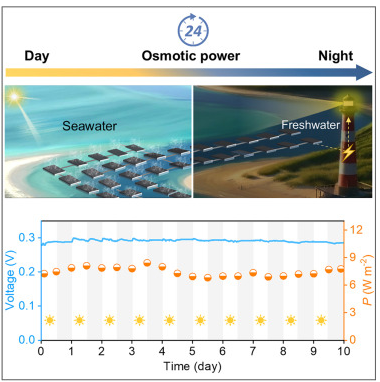
Abstract: Photovoltaics are essential for decarbonizing energy, but their output is inherently intermittent, creating a persistent mismatch with round-the-clock electricity demand. Here, we investigate a complementary approach: generating electricity from salinity gradients by using ion-selective membranes to convert the natural movement of salt from high to low concentration into usable electrical power. We show that this strategy sustains strong performance beyond small laboratory devices, an important prerequisite for real-world deployment. A 1 cm2 unit achieves a power density of 8.5 W m⁻2 with stable day-and-night output, while a scaled 1,000 cm2 device delivers 0.66 W m⁻2 and ampere-level current. Connecting 400 units in series yields 100 V, sufficient to directly operate common electronics and demonstrating a practical route to usable voltages through modular integration. Together, these results highlight the potential for distributed, non-intermittent renewable power by coupling daytime solar energy with continuous osmotic conversion and leveraging widely available saline streams, including industrial brines, seawater concentrates, and desalination outflows.
Link: https://www.cell.com/joule/abstract/S2542-4351(26)00043-7