Cheng Wang, Luyao Li, Weicun Chu, Zhongliang Dong, Yinlong Zhu, Xiaoming Zhao, Lixiong Yin, Riming Nie, Wanlin Guo
Journal of Energy Chemistry
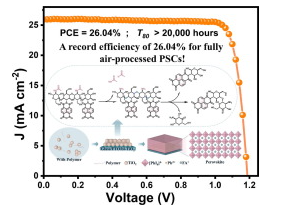
Abstract: Enhancing perovskite solar cell (PSC) performance often requires light management, interface engineering, and crystallization control, but these approaches typically involve multiple functional additives or interfacial modifiers, increasing fabrication complexity. Here, we introduce a polymer-assisted interfacial engineering strategy using a carboxymethyl chitosan (CMC)-based polymer functionalized with Cs+ (PCM-Cs+) to modify mesoporous TiO2 (mp-TiO2). Upon heating, this polymer sequentially releases functional molecular species, inducing backbone rearrangement, deacetylation, and polysaccharide cleavage. The resulting fragments passivate defects, promote TiO2 microstructural reconstruction, and enhance electronic coupling with the perovskite. These effects yield power conversion efficiencies of 25.5% and 26.04% with TiO2 and SnO2 electron transport layers, respectively. To the best of our knowledge, this represents a record efficiency for fully air-fabricated perovskite solar cells. The devices also demonstrate outstanding stability under various ISOS proto-cools, with unencapsulated mp-TiO2:PCM-Cs+ cells retaining over 97% of their initial PCE after 2,750 h dark shelf storage, projecting an estimated T80 of ∼20,000 h. This work provides a universal and scalable interfacial engineering strategy to simultaneously achieve high efficiency and long-term stability in air-processed perovskite solar cells with simplified fabrication.
Link: https://www.sciencedirect.com/science/article/pii/S2095495626001178